
On June 8, 2026, the Japan Fair Trade Commission (JFTC) published "Enforcement of the Antimonopoly Act in FY2025" (the "Report")1. Although the number of legal enforcement measures taken by the JFTC decreased in FY2025 relative to FY2024, FY2025 still recorded the second-highest number of enforcement measures taken in the past five years, indicating that the JFTC continues to enforce the Antimonopoly Act actively. This article provides an overview of the Report’s key points.
1. Increasing Trend in Legal Measures
In FY2025, the JFTC implemented a total of 15 legal measures, consisting of 11 cease-and-desist orders and 4 commitment procedures2. This represented a decrease from the 24 measures taken in FY2024.
Figure 1: Number of Legal Measures
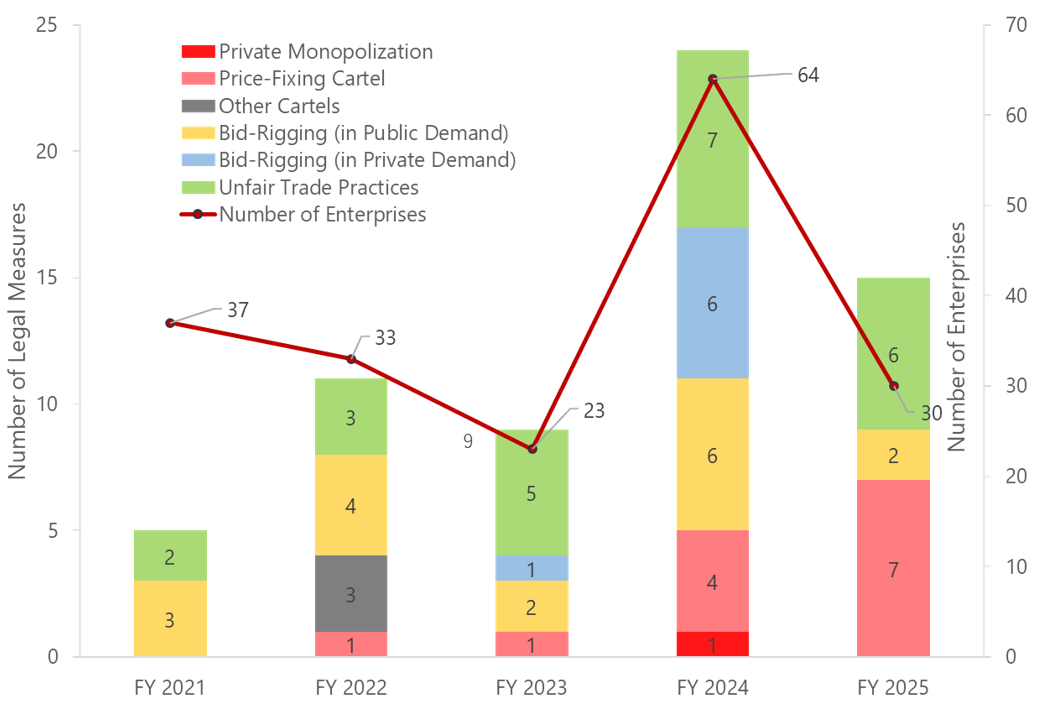
Among the notable cases were certain actions taken against large-scale price cartels and bid-rigging schemes that were relatively strict in nature. For example, in a case involving trailer manufacturers that formed a cartel in response to rising raw material costs, the JFTC issued a surcharge payment order, i.e., an administrative monetary order, of approximately JPY 3.3 billion against one violator.
In another case involving major advertising-related companies that coordinated bidding for work related to the Tokyo 2020 Olympic and Paralympic Games, the JFTC issued surcharge payment orders totaling approximately JPY 3.1 billion against 7 violators.
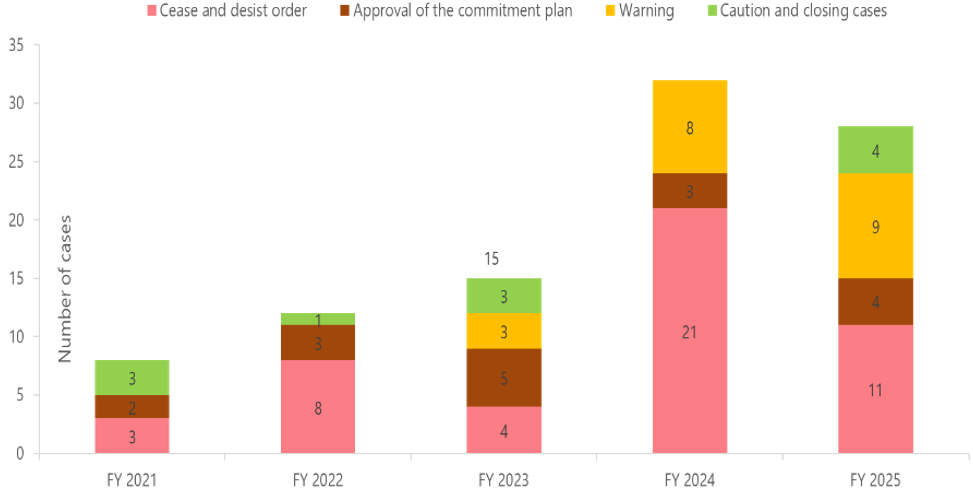
Figure 2: Number of Cease-and-Desist Orders, Approvals of the Commitment Plans, Cautions and Closing Cases
1 https://www.jftc.go.jp/houdou/pressrelease/2026/jun/260608_kanki1.pdf (In Japanese)
Please also see the summary of "Enforcement of the Antimonopoly Act in FY2025"
(https://www.jftc.go.jp/file/260626.pdf)
2 This is one of the administrative measures available under the Antimonopoly Act. If a commitment procedure, approved by the JFTC based on an application from a business operator, is not implemented as certified by the JFTC, the JFTC may revoke any approvals granted and resume its prior investigation.
2. Addressing the IT and Digital-Related Sectors
To promote the swift restoration of competition in the IT and digital-related sectors, the JFTC adopted tailored measures for each case. Examples include the following:
- Google LLC: In a case involving the blocking on certain Android smartphone manufacturers connected to certain mobile carriers of search functions made available by other competing general search function providers, the JFTC issued a cease-and-desist order requiring Google LLC to discontinue said conduct and to have an independent third-party monitor compliance for five years.
- Visa Worldwide Pte. Ltd.: In a case concerning changes made to the conditions under which preferential rates were applied to certain transactions, the JFTC approved a commitment plan requiring Visa to apply the same favorable rates in two specified situations, notify the relevant parties of the change, and accept third-party monitoring.
The JFTC also established a specialized IT and Digital Task Force to investigate suspected violations of the Antimonopoly Act in the IT and digital sectors. In FY2025, the task force received 103 reports of potentially unlawful conduct.
3. Other Observed Trends
Leniency applications for surcharge reductions totaled 182 in FY2025, an increase from 109 in the previous fiscal year. While the number of businesses granted leniency was 14, and the number of legal measures applied under the leniency program was 8, both figures were lower than in FY2024.
Furthermore, the leniency system that allows for reductions in surcharges based on cooperation with the JFTC investigations was applied to 5 cases involving 6 businesses, marking a decrease compared to the previous fiscal year.
Against a background of sharp rises in labor costs, raw material prices, and energy expenses, the JFTC issued 7 cautions in FY2025 concerning conduct related to price pass-through requests and problematic practices by shippers in logistics transactions.
4. Conclusion
As noted above, FY2025 saw fewer legal measures taken than in FY2024, but the FY2025 total remained the second highest in the past five years. The JFTC’s active enforcement of the Antimonopoly Act in an inflationary environment is therefore becoming increasingly clear. Businesses should carefully review whether price pass-through and product or service price increases are being implemented in a manner consistent with the Antimonopoly Act.
At the same time, the number of warnings and cautions has continued to increase, and this trend is likely to continue. Since warnings are publicly disclosed even though they do not constitute formal findings of violation, they may give rise to significant reputational risk. Businesses should therefore remain attentive to these developments and continue to strengthen their compliance frameworks.



'%3e%3cpath%20d='M22.2234%200H1.77187C0.792187%200%200%200.773438%200%201.72969V22.2656C0%2023.2219%200.792187%2024%201.77187%2024H22.2234C23.2031%2024%2024%2023.2219%2024%2022.2703V1.72969C24%200.773438%2023.2031%200%2022.2234%200ZM7.12031%2020.4516H3.55781V8.99531H7.12031V20.4516ZM5.33906%207.43438C4.19531%207.43438%203.27188%206.51094%203.27188%205.37187C3.27188%204.23281%204.19531%203.30937%205.33906%203.30937C6.47813%203.30937%207.40156%204.23281%207.40156%205.37187C7.40156%206.50625%206.47813%207.43438%205.33906%207.43438ZM20.4516%2020.4516H16.8937V14.8828C16.8937%2013.5562%2016.8703%2011.8453%2015.0422%2011.8453C13.1906%2011.8453%2012.9094%2013.2937%2012.9094%2014.7891V20.4516H9.35625V8.99531H12.7687V10.5609H12.8156C13.2891%209.66094%2014.4516%208.70938%2016.1813%208.70938C19.7859%208.70938%2020.4516%2011.0813%2020.4516%2014.1656V20.4516Z'%20fill='white'/%3e%3c/g%3e%3cdefs%3e%3cclipPath%20id='clip0_583_3324'%3e%3crect%20width='24'%20height='24'%20fill='white'/%3e%3c/clipPath%3e%3c/defs%3e%3c/svg%3e)
